writing
Sharpen your Axe
Apr 2026
If you have never watched competitive timbersports, you should. It is the sort of thing you flick to by accident on a Sunday afternoon and cannot look away from. The competitor stands on a horizontal log the width of a frying pan,1 swings an axe between his own feet, and cuts clean through it in under twelve seconds.2 The audience goes mad.
In some ways, the event also happened hours earlier, off camera. The same competitor sat with a pair of compasses, scratching arcs to find the exact centre point; locked the head into a jig and ground the edge. Making numerous small judgement calls - how thin to cut? thinner cuts better but thinner also chips.3
Most knowledge workers have the opposite instinct. They spend their days inside other people’s tools. Someone else’s note-taking app, someone else’s text editor, someone else’s workflow. They type faster, learn shortcuts, maybe install a plugin or two. They learn to swing the axe harder.
There is a saying, often attributed to Lincoln: “Give me six hours to chop down a tree and I will spend the first four sharpening the axe.” Lincoln never said it.4 An Oklahoma pastor coined it in 1944, quoting an anonymous lumberjack — and the original was measured in minutes, not hours. Each retelling inflated the numbers. Irrespective of the origin, it’s still true that the person who sharpens first will outperform the person who swings dully all day. By a lot.
But most people never sharpen the axe. They feel too busy chopping.
How to sharpen your mind
For a knowledge worker, ‘sharpening the axe’ means building something that makes the next thing easier to build.
My dotfiles are a public record of years of this, and most of the tools are small to the point of embarrassment. The most embarrassing is probably months, which exists because I can never remember which number August is; emoji is a fuzzy search over emoji names that copies the winner. explaincron turns 0 */4 * * * into English. rjq gives jq a live REPL, because nobody writes a jq filter correctly on the first try. 2md takes whatever HTML you pipe at it and hands back markdown; ocr | 2md does the same for screenshots. cb collapses copy and paste into one command: pipe in and it copies, pipe out and it pastes.
The same instinct, scaled up, becomes a knowledge base. I wrote tools to pull down research papers, parse them, and produce summaries in a structure I find useful. The base holds detailed prompts that describe how I like my notes organised, how I think through problems, how I want information presented back to me.
A good summarisation prompt saves me twenty minutes per paper. Over a hundred papers, that is a working week. A well-structured knowledge base means I can find my own thinking from six months ago. “Good tools remove friction. Great tools remove decisions.”
Is It Worth The Time? Now it might be!
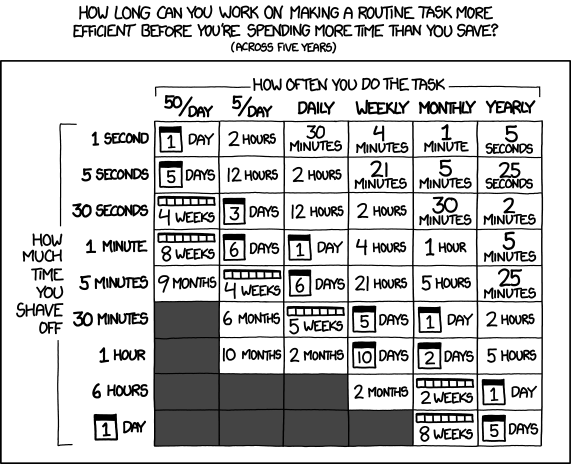
xkcd 1205. Randall Munroe, CC BY-NC 2.5.
It is a sensible chart. For years it was right.
The cost of building a small tool has collapsed. A script that once took an afternoon now takes fifteen minutes of describing what you want. The xkcd break-even line has moved so far down the chart that tasks you would never have bothered automating are now obvious candidates. The five-minute weekly chore? You can automate it in less time than doing it once by hand.
And the line keeps dropping, because the multiplier grows with every model generation. Two years ago, handing a bug to a model meant an afternoon of supervision: feeding it files, correcting its guesses, coaxing it back on course. With Fable 5 I can say “fix it”, go and make tea, and come back to a fix with a passing test.
Cheap tools change the compounding story. The ones worth paying attention to are not the tools that save you five minutes but the tools that make other tools. The xkcd chart assumes each automation is independent. They stack. The hard part is no longer justifying the first push; it is noticing the friction in the first place.
Between the Swings
A sharp blade is wasted if you spend half the day walking between trees. For a knowledge worker the walking is context switching: alt-tab to Slack to find out why a decision was made, over to a dashboard to work out what broke, into last week’s meeting notes to remember what was agreed.
So the second half of your focus should be on connection. Spend the time to make your tools reach each other, make sure your agent has as much context as you do! It should be able to access: slack threads; CI; logs; docs; meeting notes; record everything! Be sure to diarise the recording, so the model knows who said what and who wanted it.5
To find your own gaps, try a full working day without leaving Claude Code6. Every time you alt-tab to copy something in or out, write it down. Then at the end of the day, fix all the entries.
Letting Go of the Handle
The usual objection is control. If the agent can read your Slack, your logs, and your meetings, what stops it doing something you would regret?
Auto-mode is at its best for exactly the people who worry about this - it gives your fears a productive outlet. Vigilance you pay continuously; a guardrail you write once. Mine live in the same dotfiles: a hook that blocks rm -rf and offers the recoverable trash instead, and another that stops the agent reaching for the wrong package manager in a given project. Anything outward-facing follows a stricter rule: rehearse before sending - slack messages must send to a private mirror channel first.
So, please, Sharpen Your Axe
If you do knowledge work and you have not built a tool in the last month, you are probably swinging too hard and sharpening too little.
Start small. Write a script that automates something tedious. Build a template for a document you create often. Describe your preferences in enough detail that a machine could follow them. You are not wasting time.
The tree will still be there when you are done sharpening.
Footnotes
-
The underhand chop uses a 32-cm thick poplar trunk. ↩
-
The world record is 11.81 seconds, set by Brayden Meyer in 2024 — beating his own 12.01 from 2022, the run above. ↩
-
The full process is quite the ritual. You grind in 30-second bursts on a belt sander and dip the steel in water between passes so it does not overheat. After grinding, a filing jig holds the blade at the bevel angle while you work the edge, then you raise it a fraction and file a secondary. ↩
-
The earliest known version is from 1944: Reverend W. H. Alexander, pastor of the First Christian Church of Oklahoma City, attributed it to an anonymous lumberjack who measured the time in minutes. Lincoln’s name first appeared in a 1960 drilling equipment advertisement. By 1983 (Robert Allen, Creating Wealth) the tree took eight hours to fell; by 1984 (Zig Ziglar, Secrets of Closing the Sale) it took nine. The underlying idea is older still — Ecclesiastes 10:10: “If the axe is dull and its edge unsharpened, more strength is needed, but skill will bring success.” See Quote Investigator for the full trail. ↩
-
The open and closed source diarisation options are both terrible, so I trained my own; email me if you want a beta copy. ↩
-
Or insert your favourite LLM coding agent. ↩