writing
A Picture is Worth 256 Tokens
Feb 2026
“Do you know James?” a friend asks.
I’m terrible with names; much more of a faces person. Already I’m filled with dread.
“James who?”
“You know, tallish, brown hair, he was wearing a pink shirt at the hackathon on Sunday?” I have nothing.
They try harder: “He’s got a beard, glasses, kind of a round face?” Still nothing. Eventually we pull up his LinkedIn photo…
“Of course! I do know James.”
This happens to me all the time - and I’m sure to many of you. We accept that describing a face in words is hopeless.
And yet we have this saying, repeated so often we’ve mistaken it for obvious: a picture is worth a thousand words.
One look
The phrase first appeared in print in 1913, in an advertisement for the Piqua Auto Supply House in Ohio: “One Look Is Worth A Thousand Words.”1
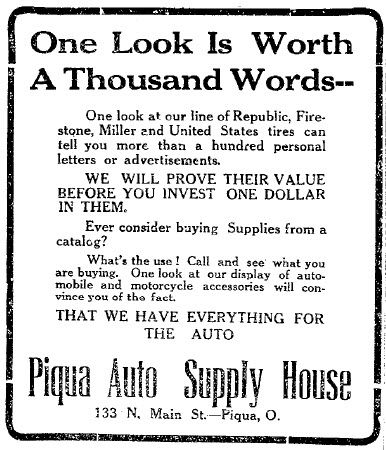
The earliest known printed use of the phrase, from the Piqua Auto Supply House, Ohio, 1913. Source: Wikimedia Commons.
A few years later, an ad man called Frederick Barnard republished the line in Printers’ Ink and, to lend it gravitas, attributed it to “a famous Japanese philosopher.” By 1927 he’d upgraded the attribution to “a Chinese proverb.” He later admitted he’d made the whole thing up. People took it more seriously that way.
Fake provenance aside, the saying makes a nice claim: a single image contains so much information that you’d need a whole essay to convey the same thing in words.
I think the claim is right, but for the wrong reasons.
The case against words
The standard reading is that pictures are rich; they have a capability to transfer vast information. But consider the reverse: maybe words are just terrible at describing what we see.
Try it. Look at any photograph and attempt to describe it in a thousand words. A picture of a bird, say: “A dark bird facing right, ruffled head feathers, yellow beak, pale background.” That’s 12 words and you’ve conveyed almost nothing about the specific bird, the light, or what on earth ‘pale background’ means.
A thousand words is exactly the length of this essay2. And they get you nowhere close to the original image. You’ll produce a vague sketch that could match thousands of different photographs.
The picture didn’t need a thousand words because it was rich. It needed a thousand words because English3 is a terrible format for visual information.
What machines see
Roman Bachmann, Jesse Allardice, and David Mizrahi recently published work on FlexTok, a system that encodes images into discrete tokens; the same kind of unit that large language models use when processing text.4 Think of a ‘token’ like a word in a new language - one designed for the purpose of describing images - “FlexTok”.
The key result: 256 FlexTok tokens can describe an image that is nearly indistinguishable from the original. One token is roughly one word.5
At one token, the system captures the raw concept: bird6. By 16 tokens it has the pose, the colouring, the beak. At 256, you’d struggle to spot the difference.7
Now look at those word descriptions. Even at the same number of words “256”, you write a page and still fail to capture what the tokens reproduce effortlessly.
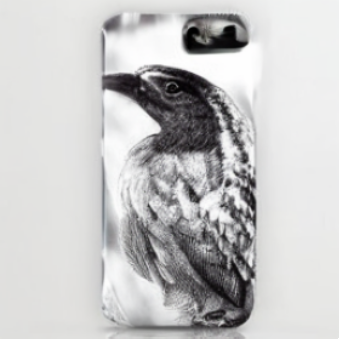
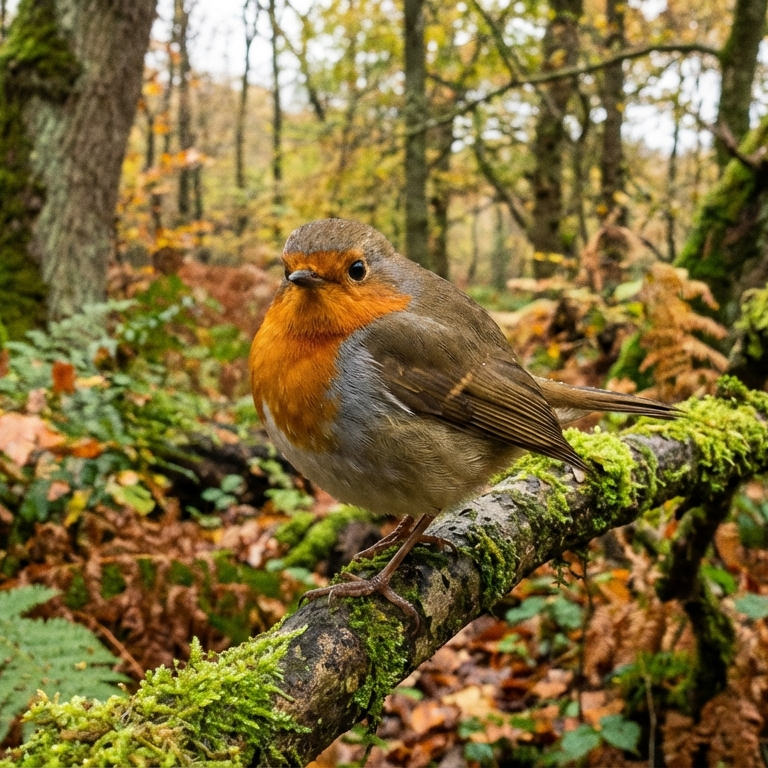
1 token / 1 word · “Bird.”
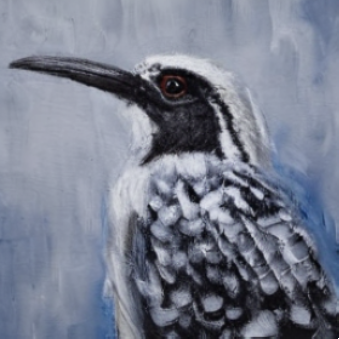
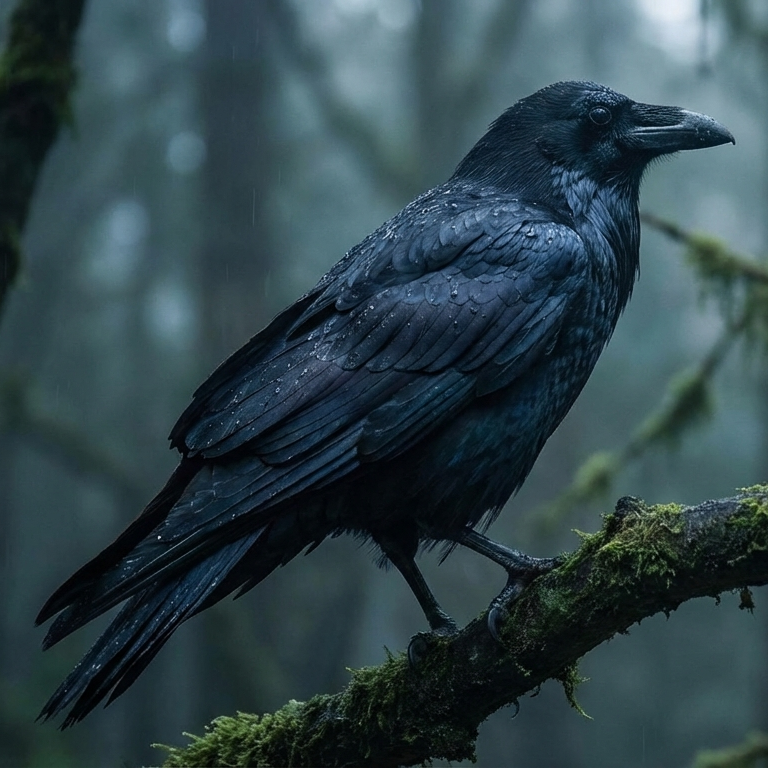
2 tokens / 2 words · “Dark bird.”
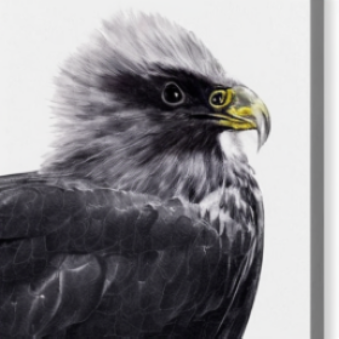
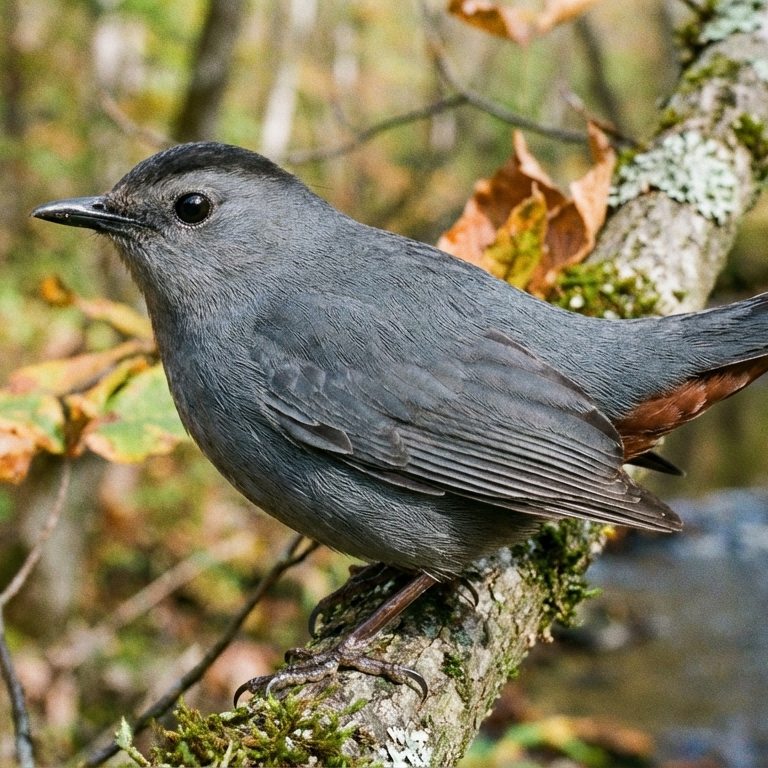
4 tokens / 4 words · “Grey bird in profile.”
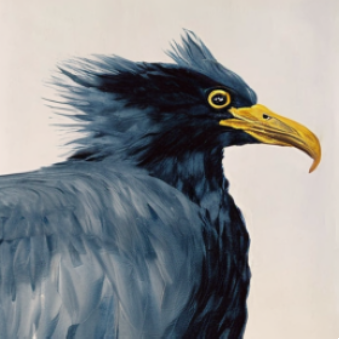
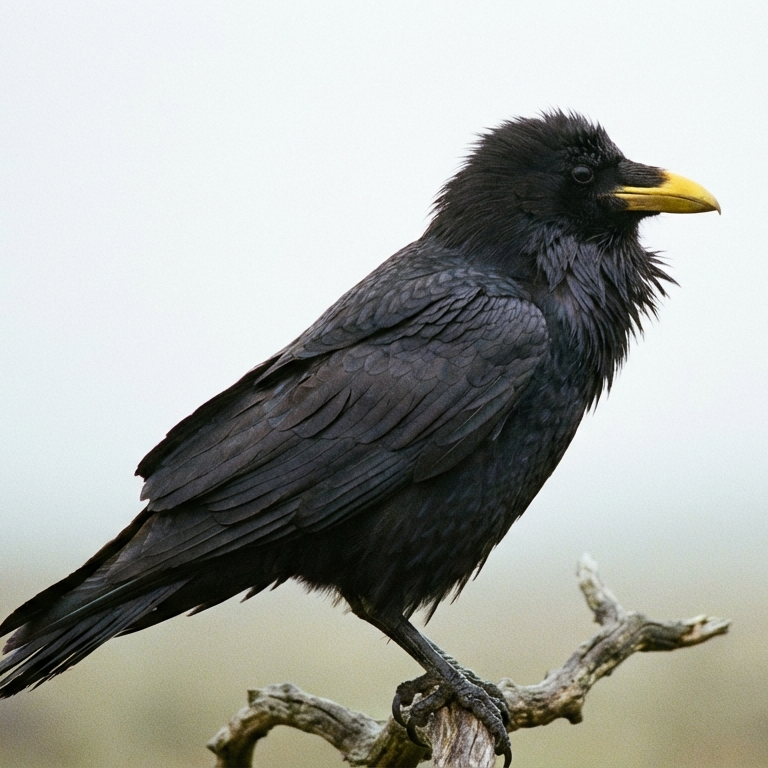
16 tokens / 16 words · “A dark bird facing right, ruffled head feathers, yellow beak, pale background.”
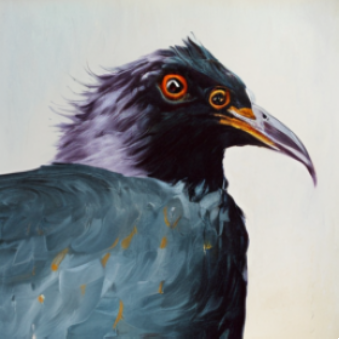
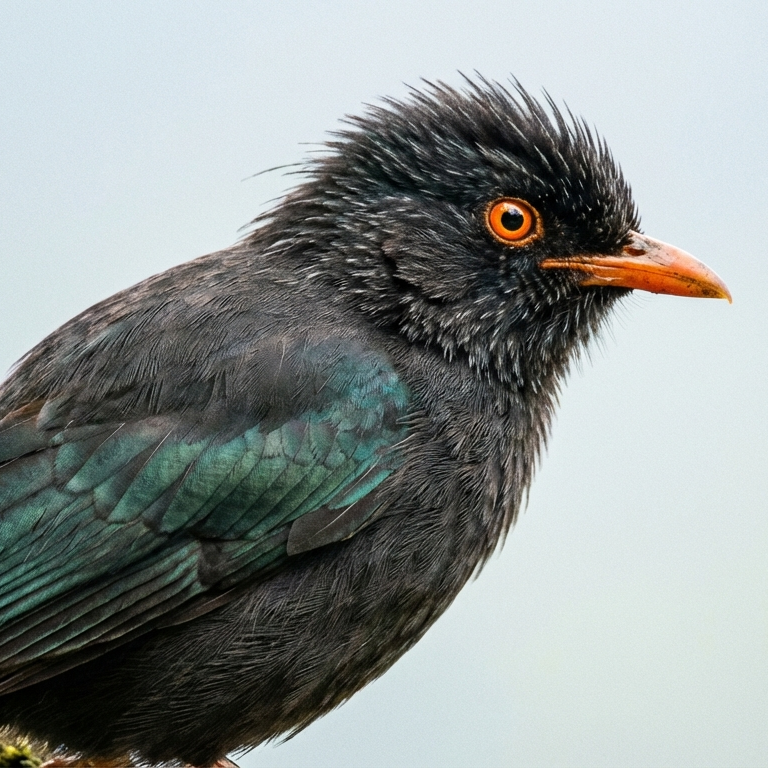
32 tokens / 32 words · “Close-up of a dark-feathered bird in profile. Ruffled crest, orange eyes, orange beak. Teal-green iridescence on the wings. Pale blue-grey background.”
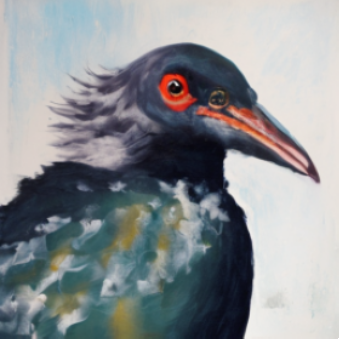
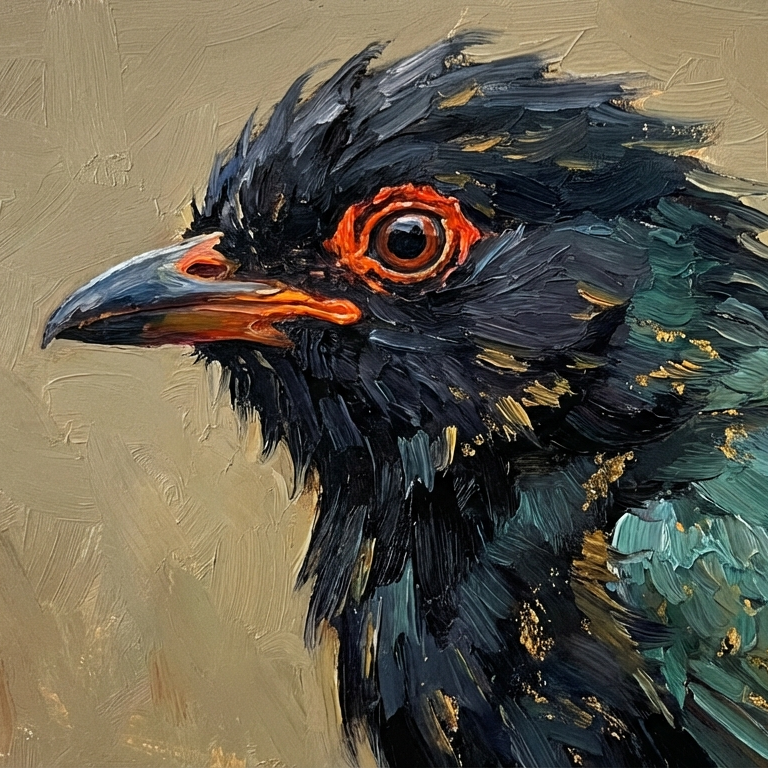
64 tokens / 64 words · “An oil painting of a bird seen in close profile from the left. The head is dark, almost black…” (+47 words truncated)
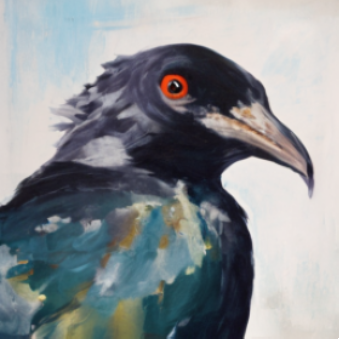
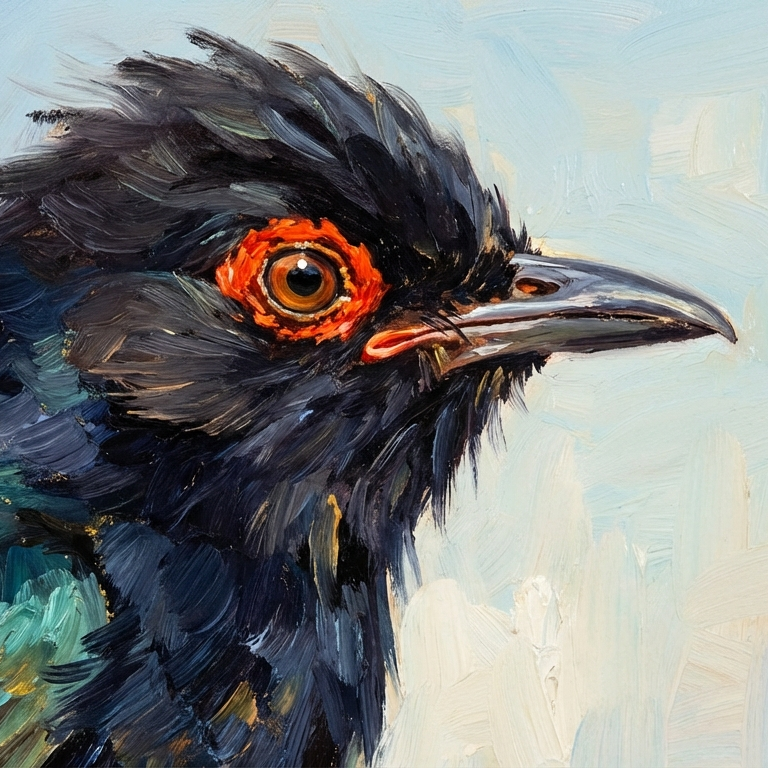
128 tokens / 128 words · “An oil painting of a bird in close-up profile, facing right. The head is dark, near-black, with loosely ruffled feathers that form a slight crest above the crown…” (+79 words truncated.)
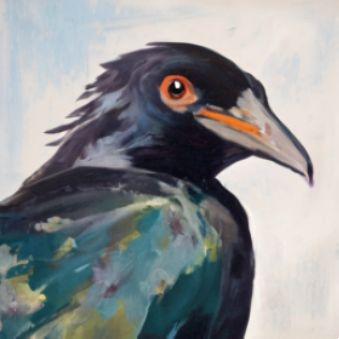
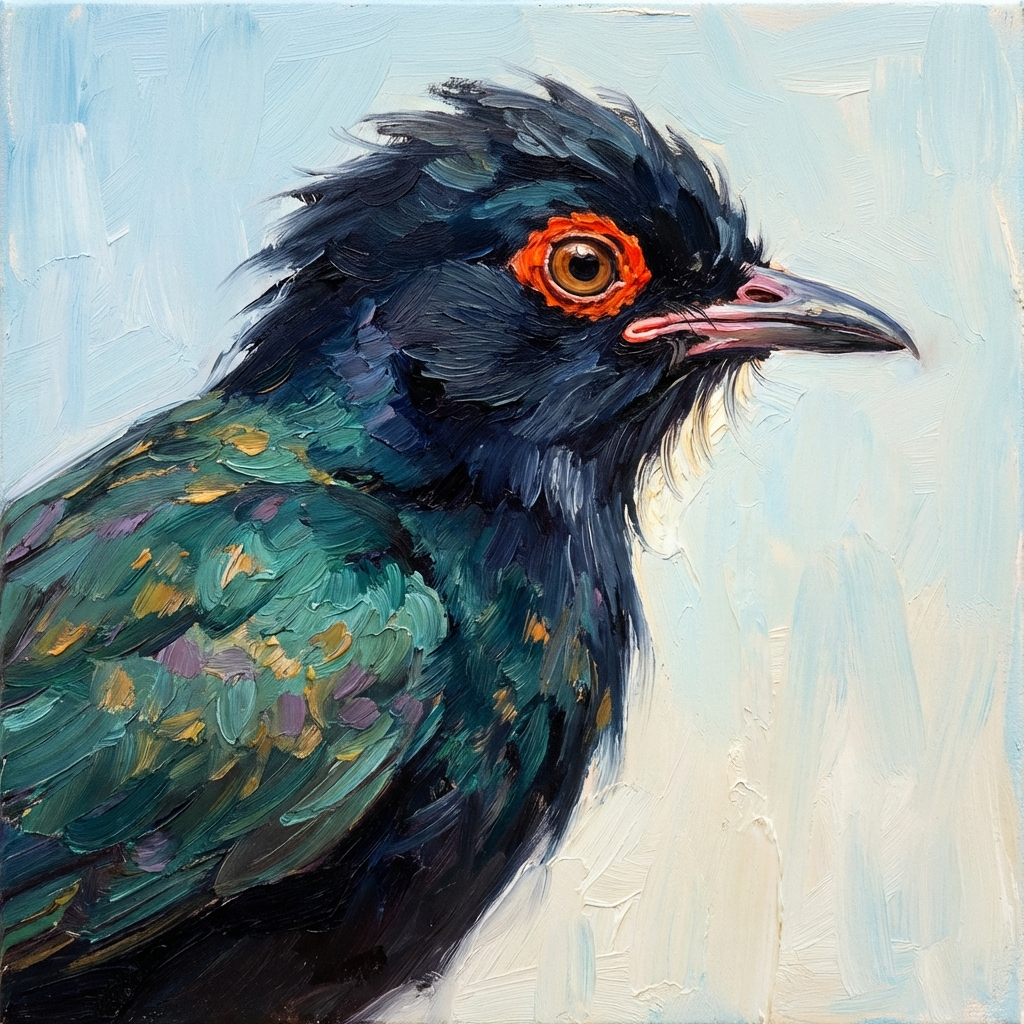
256 tokens / 256 words · “An oil painting of a bird in close-up profile, viewed from the left and facing right. The head is very dark…”8 (+188 words truncated.)
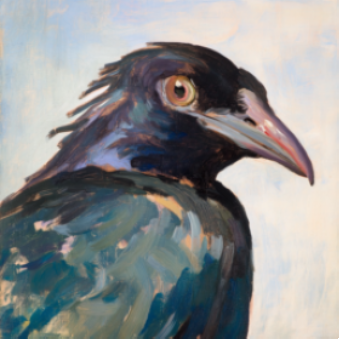
FlexTok (256 tokens) · Original · Words → Image (256 words)
What words are good at
But words aren’t useless. They’re specialised, just like the language of “FlexTok”.
Try the reverse experiment. Describe the feeling of receiving bad news you’d been expecting: the strange relief tangled up with dread with photography. Or, alternatively, explain why a particular decision was wrong, articulating the chain of reasoning that led someone astray with brush strokes.
You can do this in a few sentences - I just did! An image can’t. A photograph of someone’s face might capture that they’re feeling something, but not what they’re feeling, and certainly not why.
Words are brilliant at the interior: emotions, reasoning, motivation. They’re built for things that have no spatial dimension; for ideas, arguments, and the machinery of thought. We even coin new words when the existing ones fall short of capturing a feeling we all recognise but can’t yet name.
The right representation
So the old adage has it backwards. It isn’t a comment about the richness of images. It’s an indictment of language as a visual medium.
Nobody tries to describe a face over the phone. Nobody conveys a mathematical proof through interpretive dance (or if they do, it doesn’t go well)9.
FlexTok gives us a yardstick for comparing between very different mediums: 256 visual tokens versus 209 words of English. The visual tokens win, and the margin is pretty embarrassing.
To me, this is one of the strongest arguments for multi-modal AI. A system that can only read text is like a person describing every photograph in prose: technically possible, practically absurd. For us humans, it’s important to remember to pick the right representation for the task at hand; and just go straight for the LinkedIn photo.
Footnotes
-
The phrase was popularised by Frederick R. Barnard in Printers’ Ink, 8 December 1921. He attributed it to a fictitious Asian proverb to lend it authority; a fitting irony for an essay about the limits of language. The earliest known appearance is in a 1913 Piqua Auto Supply House advertisement. ↩
-
Verified with:
↩python3 -c "import re; c=open('index.mdx').read(); c=re.sub(r'^---.*?---\s*','',c,flags=re.DOTALL); c=re.sub(r'^import.*$','',c,flags=re.MULTILINE); c=re.sub(r'^\[\^[^\]]+\]:.*(?:\n(?: |\t).*)*','',c,flags=re.MULTILINE); c=re.sub(r'<[^>]+>','',c); c=re.sub(r'\[\^[^\]]+\]','',c); c=re.sub(r'\[([^\]]*)\]\([^)]*\)',r'\1',c); c=re.sub(r'[*_>]','',c); c=re.sub(r'https?://\S+','',c); c=re.sub(r'^#+\s*','',c,flags=re.MULTILINE); print(len(c.split()))" -
Or any other text-based language. ↩
-
Roman Bachmann et al., “FlexTok: Resampling Images into 1D Token Sequences of Flexible Length,” ICML 2025. Code at github.com/apple/ml-flextok. ↩
-
FlexTok uses Finite Scalar Quantization with levels
[8, 8, 8, 5, 5, 5]- so 64,000 tokens at 2 bytes each. This is comparable to LLM text vocabularies (~50k–100k tokens, also ~2 bytes per index). In text, one token averages ~4 characters or ~0.75 words; so the token-to-word mapping used in this grid seems a reasonable approximation. ↩ -
Perhaps superpositioning with phone case. Superpositioning is the same as English using one word for multiple meanings; the same thing is happening in this visual token language. ↩
-
The images shown are from FlexTok’s out-of-distribution Midjourney reconstructions using the d18-d28 model. FlexTok tokens are ordered hierarchically (semantic → detail); the first token captures the most salient concept, not an arbitrary slice. ↩
-
The full 209-word attempt: “An oil painting of a bird in close-up profile, viewed from the left and facing right. The head is very dark, almost black, with loosely ruffled feathers forming a slight dishevelled crest above the crown. A vivid orange-red ring encircles the eye, which has a small dark pupil set within a warm amber iris. The beak is slender, tapering to a fine dark point; it is dark grey along its length with a subtle pinkish hue near the base of the lower mandible. The beak is slightly open. Beneath the chin, a few fine pale feathers catch the light. The neck transitions from deep navy-black into the body, where the plumage shifts dramatically. Across the shoulder and upper wing, feathers display a rich teal-green iridescence, interrupted by flecks of gold, ochre, and occasional dull purple. The texture is thick and painterly; individual brushstrokes are visible, giving the feathers an almost impasto quality. The lower body disappears into darker shadow at the bottom-left of the frame. The background is soft and unfocused, blending from pale blue on the left to cream-white on the right, rendered in loose vertical strokes. The overall composition is intimate and closely cropped, filling the square canvas almost entirely with the bird’s head and upper body.” Generated by an LLM. ↩