writing
For the... Sabrinas
Nov 2026
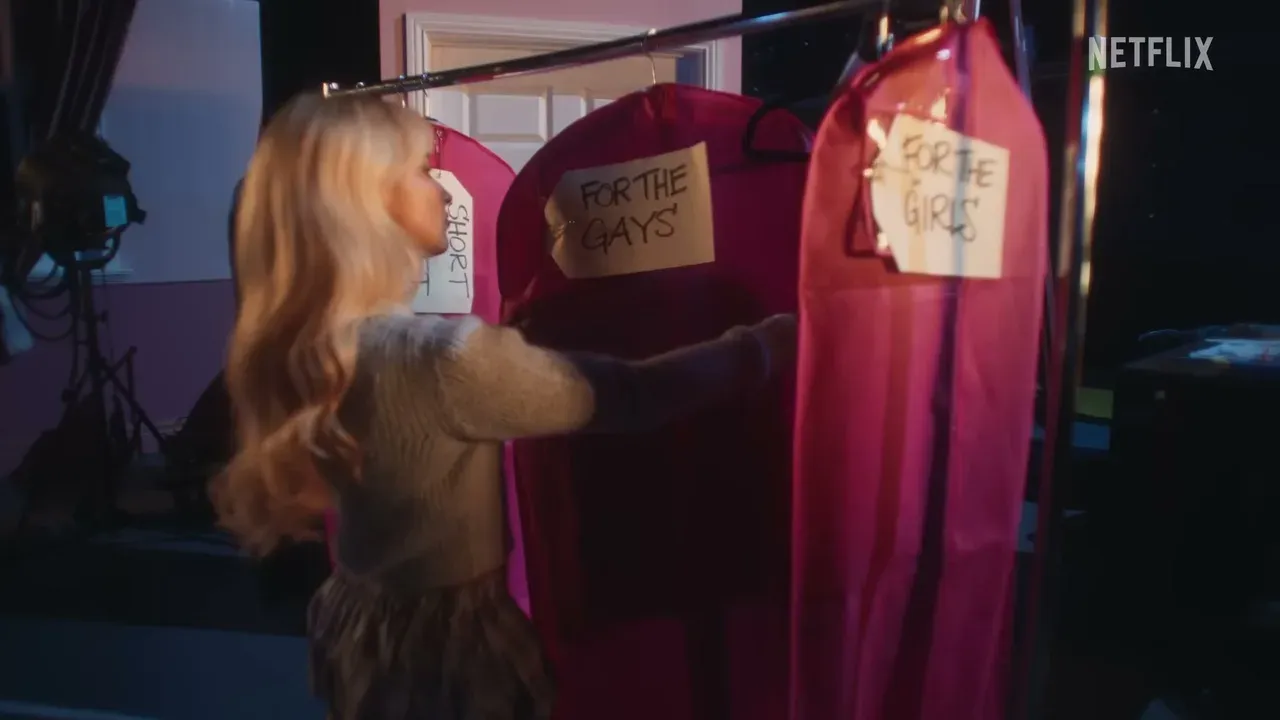
The hanger rail in A Nonsense Christmas with Sabrina Carpenter, from the official trailer.
In A Nonsense Christmas, Sabrina Carpenter chooses her outfit from three hangers, labelled ‘For the Girls’, ‘For the Gays’, and an empty one, ‘For the Guys’.
She picks
On paper, she is this generation’s great romantic. The songs are about boys, sex — and about how they come up short1.
In Short n’ Sweet’s opening track Taste, she makes out with Jenna Ortega. Yet few read her as anywhere on the queer spectrum2; she herself complains that the Lord neglected to grant her a “gay awakenin’”3.
Watch the videos closely, and it’s hard to read her as much of a romantic at all.
When a scene partner — or love interest — shares the frame, her eyes are elsewhere. She stares off screen or at the camera.
So who is all of this for?
Where she looks
To see if our4 hunch was right, I took all of her music videos and analysed where she looks and how much feeling is in the look5. That should allow us to compare like for like.
In case you haven’t analysed these videos to death:
- Nonsense (2022): she and two friends get ready and go to a party, where each flirts with a boy.
- Feather (2023): men who harass her die one gory accident after another, while she dances at their funeral.
- Espresso (2024): a 1960s beach day where men wait on her, until the police take her away.
- Please Please Please (2024): she picks up her boyfriend for a crime spree.
- Taste (2024): she and her ex’s new girlfriend (Jenna Ortega) keep killing each other, while only the boyfriend stays dead.
- Manchild (2025): a surreal take on hitchhiking from one man’s car to the next.
- Tears (2025): a Rocky Horror homage where she crawls from a crashed car to a house of strange people and stranger parties.
- House Tour (2026): she and two friends burgle a mansion, taking back her Grammy on the way out.
The simplest answer from this analysis is you. Leaving out Please Please Please for now, which we’ll come back to, more than a third of the time she’s looking straight at you.
Here are her most animated looks into camera for each video:
The rest of the time her gaze is on6:
| Where she looks | Seconds | Share of time |
|---|---|---|
| Off-frame | 193 | 44% |
| An object | 63 | 14% |
| Herself | 61 | 14% |
| Friends or a crowd | 51 | 12% |
| A man | 38 | 9% |
| Another woman | 31 | 7% |
After you, the person she looks at most is herself.
Mirror, mirror, on the wall
Mirrors appear in every Sabrina Carpenter video: one second in every fifteen, more than any of the other pop stars I coded7, and three times as often as Chappell Roan. She spends 61 seconds looking at herself, more than at any man or woman in her videos.
Often the mirror is for her lipstick: the vanity in Nonsense; her phone while men fight over her in Feather; the glass of the prison release booth in Please Please Please; the blade of a cleaver in Taste.
So far, you’d be forgiven for thinking she looks like a narcissist: she looks at you looking at her, then at herself, and at hardly anyone else.
For the guys: death
For a singer who ostensibly sings about nothing but men, she barely looks at one. In five of the seven videos she gives a man less than ten seconds in total. Across all seven8, men get 38 seconds: less than she spends on herself (61), and barely more than on other women (31).
When she does look, he dies (Feather; Taste) or gets hurt (Manchild; Please Please Please). Her fans keep count: “ITS NEVER A SABRINA CARPENTER MUSIC VIDEO WITHOUT A MANS DEATH!”
The few looks a man does get are rarely truly admiring. There is genuine emotional content in Sabrina’s gaze, but it often comes with a knowing glee as they promptly self-immolate. In Feather she pulls a man towards her by his tie before trapping him in the lift, while she smirks over her shoulder at you; in the gym, men brawl behind her while she takes selfies and does her lipstick; Manchild’s men get deadpan side-eye or broad smiles before they drive off a cliff; and in House Tour only a dismissive wave.
Not all men
There is one man who survives her attention. In Please Please Please, the man is Barry Keoghan; the video was their hard launch: how she went public with their relationship. This video alone holds 45 of the 83 seconds she spends looking at a man across all eight videos; and she looks at you half as much as usual.
Here, for once, she looks at a man the way the songs promise - this video is about Barry and the chemistry is undeniable.
For the girls: a hug
For songs so full of sex, remarkably little of it is steamy. The sexual set pieces are oddly cold. Outside of Barry, she kisses another person twice, and looks at neither of them. The most explicit, with Jenna Ortega, starts with Jenna kissing the man; when she turns to Sabrina, Sabrina’s eyes are closed and lips static. In Manchild, we just see a flat, unresponsive stare past him as he fumbles around.
The real warmth is devoted to her friends. She smiles or laughs for almost half the time she looks at them; against a fifth of the time at the men who aren’t Barry. In House Tour, every warm look9 goes to the other women robbing the house with her. She is the motherly mastermind of the break-in: she indulges her friends, listening to them reading on the edge of her bath; gifts them stolen jewellery; and she stays on top, lying back while they push her around on a piano. The scenes have all the trappings of seduction (lingerie, bubble baths, a bed), but the looks are a friend’s.
The warmth is real because the friendships are. The two women are Margaret Qualley and Madelyn Cline, who has said of Carpenter, “We’ve been friends for a long time.” The two girls who get ready with her in Nonsense are her real-life best friends, Paloma Sandoval and Whitney Peak. Even Jenna Ortega, whom she kills and kisses in Taste, is a friend from their Disney days. The chemistry on screen turns up only where it exists off screen.
The songs themselves are also warmth from a friend. She never sings to the boy. She sings about him — to you — the way a friend would complain about a man over a few glasses of wine. We’ve all met the one who’s all talk; who never grows up; and the joke tends to land because you’ve dated him too; you might still be. She, figuratively10, winks and makes you a conspirator; as she says herself, it is “the way that I communicate with my friends, my family, and with lovers”. The videos suggest the friends come first.
The videos and songs give you a friend’s perspective — normally with eyes rolling behind ‘his’ back. They also give you the hug when it’s all over, as she whispers in your ear that she never liked him anyway.
For the gays: camp
“The Gays” hanger is the right choice for Sabrina. The videos are camp. She portrays “not a woman, but a ‘woman’”11. To see camp is to understand being as playing a role. It is full of air-quotes and nods to the audience. Sabrina’s men are not boyfriends but ‘boyfriends’: they carry her, oil her, fight over her and die, and nobody, least of all her, takes them seriously. Camp flirts with two meanings at once: one for outsiders, and one for those in the know. To outsiders, the songs are about men; to the gays, they’re about ‘men’.
Camp doesn’t have to be cold, though. It can be tender. Chappell Roan, who turns up in the same Christmas special, is every bit as camp: wigs, sex, and a man who comes to a bad end. In My Kink is Karma she seduces a clown and then shoots him through the head with an arrow — sound familiar? But her other partners are women, and with them the intimacy is real.
In Casual she looks at the Siren for 71 seconds, and the Siren looks back; at 2:30 they hold each other’s eyes, and either of them may start a touch or a kiss. In Red Wine Supernova she puts her hand on the magician’s face, and when she glances over, the magician laughs back. Leave out the camera and each singer’s top partner video, and Chappell still spends a fifth of her time looking at a partner; Sabrina, a tenth.
Sabrina has nothing similar when looking at women. Her looks at Jenna Ortega are glares, gasps and smirks, and the kiss is Jenna’s character’s move: a gloved hand on Sabrina’s jaw. Her looks at the others are play - the nearest thing to touch is a finger on the nose.
That’s why so few read her as queer. There is nobody on screen she looks at the way Chappell looks at the Siren: no woman, and, Barry aside, no man either.
So if no one in the videos gets her romance, perhaps it all goes to herself. That’s the narcissist’s answer we touched on before.
Not Narcissus
Narcissus can’t look away from the pool. Sabrina doesn’t linger. Her looks at herself are appraisal, not adoration; a director’s eye: she checks her lipstick before she goes out, and often just before a weapon, a fight or a guard. Indeed she sings so herself, in Please Please Please: “Don’t bring me to tears when I just did my makeup so nice.”
The numbers agree — of the 34 seconds she spends looking into a mirror, she smiles for three. She smiles at you for 70 of 243.
For the Sabrinas
Let’s go back to the start - Nonsense. She and two friends get ready, go to a party, and each flirts with a boy.
The boy in the ‘Dipshit’ cap is Sabrina, in a wig and a baggy jacket. “I wanted us to play our own boyfriends,” she told Rolling Stone12. The warmest looks she gives a man outside Please Please Please are on that couch, laughing with herself.
Narcissus wants to be looked at by himself; Sabrina wants you to watch her look. She is the star — and, by House Tour, she’s the show’s director.
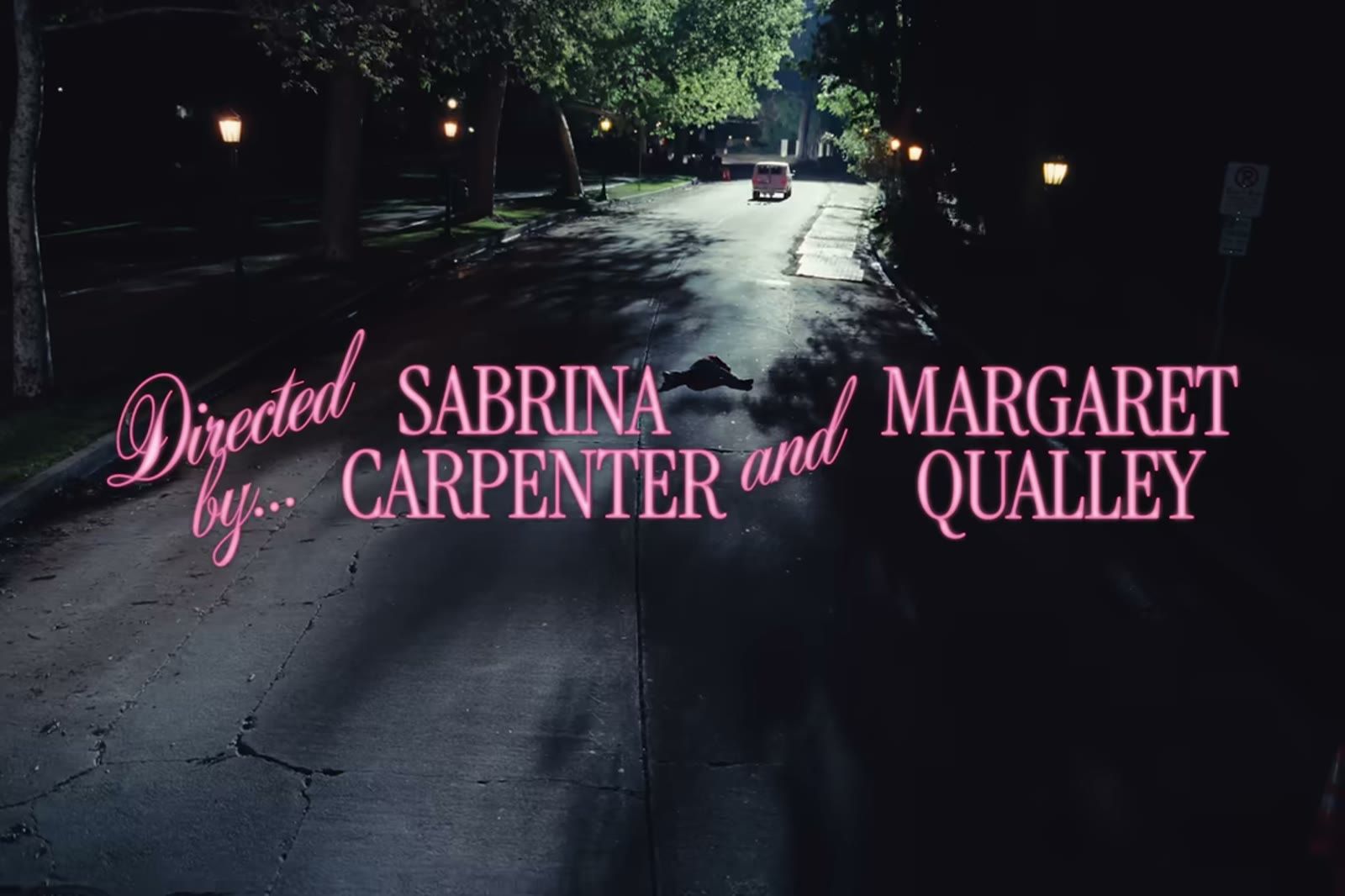
The closing title of House Tour, over the man their van has just run down.
So who is it all for? Not the guys, that’s for sure. She did pick the Gays hanger, and she wears it well: the outfit is camp, and the girls get the warmth. But really the choice is hers. She picks the scene, the boy and, in the end, the camera; and when the scene calls for someone to love, she casts herself.
For the Sabrinas.
Footnotes
-
42 of her 46 songs centre on a man. Sex is on the rise over her last three albums: 15% -> 42% -> 58% of songs. The man disappoints in 59% of the songs, almost always romantically; he’s either immature; all talk; or gone. ↩
-
Amy’s “My bisexual Brat awakening” spurred me to do the analysis. It’s great - go read it (after). ↩
-
Angie Martoccio’s Rolling Stone cover story, paraphrasing Carpenter’s own complaint in her song Slim Pickins. The same piece has her answer to critics of her act, emphasis mine: “those are the songs that you’ve made popular. Clearly you love sex.” ↩
-
My partner deserves a lot of the credit for this - not only the empty hanger joke - but also the thesis itself. ↩
-
We extracted one still per second; described the scene for each, and as a first pass extracted an emotional valence if there was a visible expression, from the visuals alone without the rest of the story (e.g. “flat stare” vs “wide-eyed laugh”). Every share counts only the seconds where her eyes are readable, a little under half the footage. A model (Claude Sonnet 5.5) did the coding, with an ad hoc human review afterwards — this is not my most rigorous piece of data analysis. ↩
-
Every number from here on is in seconds, across the seven videos other than Please Please Please, unless we note otherwise. ↩
-
Eight videos each from Taylor Swift, Britney Spears, Billie Eilish and Chappell Roan. Share of footage with a mirror in shot: Sabrina 6.7%, Taylor 5.6%, Britney 4.2%, Billie 3.5%, Chappell 2.1%. ↩
-
A careful reader will notice we’ve again left out Please Please Please; we’ll come back to it, don’t worry. ↩
-
At someone in the frame. ↩
-
I checked; she actually never winks in the videos. ↩
-
Susan Sontag, “Notes on ‘Camp’”, Partisan Review 31, no. 4 (Fall 1964). ↩
Comments
Select any passage to comment on it. Everyone viewing comments here sees your comment and name; leave the name blank and you get a made-up one. Your email, if you give it, only reaches me. You can edit or resolve your comments later from this browser.
Loading comments…