writing
Does a watermark catch what an AI detector catches?
Nov 2026
Ask Gemini for an image of a plain black square and what comes back is only black in the way a hostel bedspread is clean. Shine a light on it and it’s covered in Google’s glitchy digital watermark1.

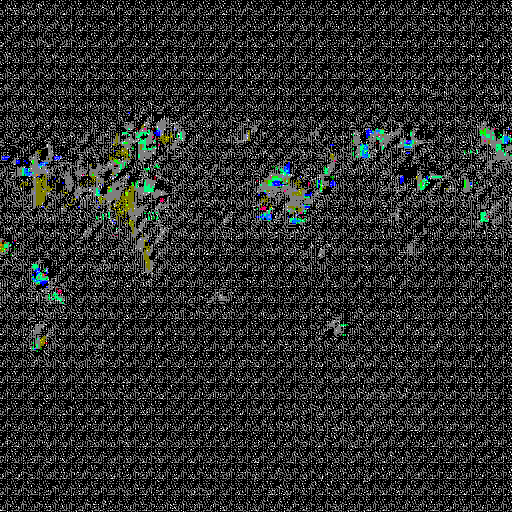
Google (Gemini), OpenAI (ChatGPT), and more recently Anthropic (Claude) all plant a hidden pattern into their models’ output. In fact, they are now required to do this under the European Union AI Act.2
The pattern — a watermark — encodes a short chunk of information (for instance the name of the model that generated it; or the user ID). Watermarks all follow the techniques outlined in the SynthID paper, which make them unreadable to a normal reader but detectable to anyone who knows the ‘key’ that encodes the pattern.
AI uses randomness to generate responses. Instead of using an arbitrary random number generator to pick the next word, watermarking uses the key and a few words that come before it to decide which word the model should pick. Much frantic keyboard typing has been wasted over the impact of these on the quality of the output — to prevent them turning their rabid gaze on me, let me be clear.
You cannot watermark a deterministic response.
If you ask it to respond with “Quote Hamlet’s soliloquy starting with To be, or not to be” there will be no watermark. If you ask it to generate 100 random numbers, there will be a very clear one. Watermark strength is proportional to the ‘randomness’ of the output. Images have a lot of arbitrary decisions and lots of information that can be ‘hidden’ without loss of meaning. Text is harder.
To get a better intuition for watermarking you can consider this simplistic — and more damaging — watermarking process3. We can split words into a red-list / blue-list and we bias the model to prefer words in the blue list. If we then see more blue words than random choice (or natural randomness) would suggest, then we know that the model has our fingerprint.
A 10-tonne 'fatberg' formed from hardened waste has been removed from a drain underneath one of the city's most exclusive streets. The enormous mass, 40 metres long and made of fat and wet wipes, was so dense that it split the 1940s sewer under Chelsea. The sludge removed so far weighs about as much as five Porsche 911s.
The trick here is we need to know what was in the red-list and blue-list to determine if there is a watermark — this, in this case, is our key! Without the key, we can’t tell which words are more red or more blue.
AI detectors, such as Pangram, GPTZero or Isogram, work differently.
Detectors read the text and judge only whether an AI wrote it. You can think of a watermark as a signature; while a detector is a handwriting expert. Retype the letter and the signature is gone, but the handwriting stays.
Detectors scan for the distinctive4 style of AI writing, with a number of inscrutable rules that we don’t really understand; but we can proxy it as knowing the ‘tells’ of a model — the words it likes; the way it constructs sentences. You can often do this yourself if you’ve read a lot of AI-written text:
In a pivotal operation, engineers have removed a 10-tonne 'fatberg' from beneath one of London's most exclusive streets — a discovery that underscores the hidden cost of everyday habits. The 40-metre mass of fat and wet wipes was so heavy it broke the 1940s sewer, highlighting a crucial truth: this is not just a blockage, but a testament to modern consumption. Experts believe the incident serves as a wake-up call about the vital role sewers play in a vibrant city. The waste weighs as much as five Porsche 911s — yet the lesson is clear, simple and urgent. Ultimately, the future of London's sewers depends on all of us.
Generated Text
To give you an empirical understanding of how these differ, we took 200 passages from news reports5 and then either generated them from scratch, edited them, or paraphrased them using an open Google model, which we watermarked with our own custom key6.
Neither detector flags any of the 200 human texts. SynthID catches the text it watermarks almost every time, 199 of 200, and nothing else. The same model writing without the watermark goes unflagged. That is not a hypothetical: xAI leaves its text watermark off unless the customer switches it on.7
One paraphrase by the same model, without the watermark, wipes the mark from all but 3 texts. Isogram8 — my AI detector — needs no key, so the watermark makes no difference to it. It flags every generated text: watermarked, plain or paraphrased.
This means it is trivial for bad actors to circumvent — signatures are still pretty brittle for the same reason they make very little difference to the output (they just use the randomness that is already there); and hence a rewriter will typically take the ‘odd’ word choices and re-roll the deck.
Edited Text
Both techniques struggle with edited text. Here we take the original human passage and have the model edit it under the watermark, attempting to keep as much of the human wording as is reasonable. Every word the model keeps is a word the watermark can’t be encoded in; equally there is less freedom for the model to impose its own style.
Notably, SynthID flags just over half of the watermarked edits and Isogram nearly three quarters, but they mostly miss different texts: 84 are caught by both, 27 by SynthID alone and 59 by Isogram alone. Run both and you catch 85%.
The size of the edit9 matters to Isogram and not to SynthID. Isogram catches under half of the lightest edits and most of the heaviest; SynthID catches about half at every size. So it is worth knowing that watermarks do still flag light-touch AI transforms of human text.
Detectors can be configured relatively easily to not flag proofreading edits; watermarks however are harder, because it’s tricky to distinguish ‘light touch edits’ where the model has a weaker signal, from less random text where the model has a weaker signal.
Checking SynthID without Google
Everything so far used a fingerprint and key we made ourselves. To check a watermark you need the key. Without it you can’t see any fingerprints (it is understandably subtle), though that subtlety means a paraphrase will still wipe it away. So what do you do if you want to check an image for a SynthID fingerprint?
Google’s SynthID checker is ‘available to the public’ in the same way a hotel beach is public, at the bottom of a cliff, behind a locked gate. To use it, you must first sign in with Google; they used to just allow you to use Google Search10. You then get about ten checks a day before it locks you out for uploading images that “look too alike”. It doesn’t take text, only images. Also, its terms forbid scripts, so you must manually enter each image you want to check. There is, apparently, an API, but only for ‘trusted partners’. Currently the “allowlist intake form” is paused and isn’t taking new participants. Even when you do get into that, I discovered that it doesn’t read the watermark at all: it’s a trained AI detector11.
After dealing with such bureaucracy, I turned to GitHub, the internet’s unpaid research department, for someone who has reverse engineered it. reverse-SynthID is the closest build from the same solid-colour Gemini images.12 On those it works. On images with anything in them, it’s a 50-50.
So, without Google’s blessing, you can’t check it.
The same is true for OpenAI; Anthropic; Grok — they play by the law, but that doesn’t mean they need to make it easy. Why not create a problem then charge API access to get the solution?
The only justification I can craft is that once you have the ability to check it en masse, you’ll gain enough understanding of the fingerprint encoding scheme that you could start injecting fake fingerprints over the top of existing content — creating fake fake content if you will — there are a bunch of reasons.13
A watermark can also encode more information than just whether it was generated by AI or not. I think one of the more useful things it could tell you is what model generated this content.
I’ve been trying to answer that with a detector (i.e. learn the style of Google’s Nano Banana vs GPT Image), which would then sit outside of anyone’s walled garden. Currently, on image models it has never been trained on (Imagen 3/4), Isogram picks out Google a little more often than chance; that’s not good enough yet, but it’s more than anyone else offers.
Provenance metadata
A completely different approach is to add metadata to generated images. This is the same process that happens automatically when you take a photo with an iPhone: it’ll embed the location of where the picture was taken, and with what device, right into the file.
Google, OpenAI, and Adobe do the same with a signed C2PA manifest which says which model made the image.
Like location tags on images, it’s incredibly easy to lose. A watermark is embedded in the pixels; while metadata sits beside them, so a screenshot or a re-save strips it out. Of the known fake AI images in OpenFake - an AI detection dataset - only 6 of 160 Google images include one, and 51 of 140 from OpenAI.14
We also purposefully strip this metadata; there was a while where social media didn’t strip it and anyone could easily grab a map to your family home when you went home for Christmas.
| Generator | Images | C2PA manifest | IPTC “AI-generated” tag | Isogram flags |
|---|---|---|---|---|
| Nano Banana Pro (Google) | 80 | 6 | 7 | 67 |
| Veo 3 frames (Google) | 80 | 0 | 0 | 65 |
| GPT Image 2 (OpenAI) | 37 | 4 | 4 | 27 |
| GPT Image 1.5 (OpenAI) | 80 | 45 | 45 | 60 |
| Sora 2 frames (OpenAI) | 23 | 2 | 2 | 19 |
| FLUX.2 klein | 80 | 0 | 0 | 18 |
| Z-Image Turbo | 80 | 0 | 0 | 41 |
| Midjourney 7 | 80 | 0 | 80 | 40 |
| Seedream 5 | 14 | 2 | 1 | 14 |
| Real photos (DOCCI) | 80 | 0 | 0 | 0 |
Who holds the key
A watermark answers its question perfectly, for whoever holds the key. A teacher with a suspicious essay, or an editor with a suspicious photo, doesn’t hold it. They can read the manifest, if no one has stripped it; they can run a detector, which reads the work itself; or they can upload it to every single company to check for a watermark for their particular model.
Footnotes
-
Very likely, although they’ve never confirmed it officially. ↩
-
“Providers of AI systems, including general-purpose AI systems, generating synthetic audio, image, video or text content, shall ensure that the outputs of the AI system are marked in a machine-readable format and detectable as artificially generated or manipulated.” EU AI Act ↩
-
SynthID-Text picks words by a keyed tournament rather than a list; but we’re building intuition here. ↩
-
Currently distinctive - who knows if that will stay true. ↩
-
200 CNN/DailyMail article passages (of 120 to 300 words). Each passage produces: the human text; the model writing a new article on the same topic, with and without the watermark; the watermarked article paraphrased by the same model without it; and the human text edited by the model, with and without it. Generator:
google/gemma-2-9b-it, top-k 40, temperature 1. ↩ -
SynthID-Text as released in Hugging Face transformers (30 tournament layers looking over the last 5 tokens for context). The detector is a simple p-value score over the keyed g-values; where we flag it at p < 0.01 (a 1% false-positive rate per text). Google’s production detector is a Bayesian model trained per key, so this is likely a lower bound on it. ↩
-
xAI, “Watermarking”: “Text watermarking is off by default. Team admins can turn it on per model.” ↩
-
My trained AI Detection model isogram.hails.info. ↩
-
Linq-Embed-Mistral cosine distance between the human text and its edit, the label Isogram trains on. Intervals on rates are Wilson; on AUROC, bootstraps over seeds. ↩
-
Google themselves previously offered a particularly hidden, no-auth method: if you uploaded an image to Google Image search, and went to ‘About this image’, it would show if the image was Google AI-generated. ↩
-
Google’s Content Detection API (InfoQ, May 2026): previewed with “a group of trusted partners, including Shutterstock, Snap, Fox Sport, Canva”, it “uses machine learning models to analyze pixel-level artifacts, noise patterns, and spectral anomalies”, spotting “AI content made by both Google and other popular models” https://www.infoq.com/news/2026/05/google-synthid-content-detection/ ↩
-
The image probe in our graphs is reverse-SynthID run for non-commercial research under its licence. ↩
-
Pull my leg why don’t you! Okay so the reason I find this unpersuasive is that you can easily encrypt the key before you then encode it - they could potentially encode something that on the surface looks similar to it (e.g. the glitch pattern in the image) but if you tried to extract the underlying metadata it wouldn’t work and would break the validation checks. Easily fixed. ↩
-
Measured by a byte search of each stored file for the C2PA manifest label and the IPTC
trainedAlgorithmicMediasource type. Neither is verified against a signature. ↩
Comments
Select any passage to comment on it. Everyone viewing comments here sees your comment and name; leave the name blank and you get a made-up one. Your email, if you give it, only reaches me. You can edit or resolve your comments later from this browser.
Loading comments…